The VA Is Blocking an Evidence-Based Treatment

Veterans deserve every available spine care option. The VA just took one away.

On December 1, 2025, a VA memo cut off Veterans' access to annular fibrin injections — a minimally invasive treatment for chronic back pain. Add your name to demand it be restored.

Takes under 60 seconds · All signers welcome.

Annular fibrin injection at a glance
827
Patients in the landmark Pauza et al. (2024) registry
VA: "insufficient evidence"
50%
Of patients achieved clinically meaningful pain & function improvement at 12 months (Pauza et al., 2024)
VA: "not medically necessary"
25+
Years fibrin sealant has been FDA-approved in surgical use
Same substance — already trusted in OR
Dec 1
2025 — the day Veterans lost access without warning
A memo. No clinical review. No phase-out.

Back pain is the #1 service-connected disability at the VA.

#1
leading service-connected disability at the VA
~60%
of Veterans report chronic musculoskeletal pain
the rate of the general population

Back pain isn't a minor complaint for Veterans — it's the single most common service-connected condition in the VA system. Nearly ~60% of Veterans report chronic musculoskeletal pain, almost 3× the rate of the general population. Years of carrying heavy loads, high-impact operations, and physical trauma leave lasting damage to the spine.

What Was Taken Away

When medications, physical therapy, and injections stop working, Veterans are funneled to a single option: invasive, irreversible surgery. Fusion permanently alters spinal mechanics, carries real surgical risk, and often leads to adjacent segment breakdown over time.

There was a logical step between failed conservative care and irreversible surgery. Annular fibrin injection (AFI), a minimally invasive, outpatient procedure — could seal the disc tear at the source and restore function without hardware or hospitalization. It does not eliminate surgery as a future option.

On December 1, 2025, VA Clinical Determination CDI 00059 eliminated AFI as an option — designating AFI as "investigational, experimental, and not medically necessary" with no clinical panel, no phase-out period, and no alternative pathway offered to Veterans already mid-treatment. That designation conflicts with over two decades of published evidence. The science below explains why.

The Treatment Ladder
STEPS 1–3 Conservative Care Medications (NSAIDs, muscle relaxants, opioids) Physical therapy · Epidural steroid injections CONSERVATIVE CARE FAILS DENIED BY CDI 00059 STEP 4 Annular Fibrin Injection (AFI) Minimally invasive · Outpatient · Reversible ⚠ Currently blocked by VA CDI 00059 STEP 5 Irreversible Surgery Lumbar spinal fusion · Laminectomy / laminotomy Total disc replacement · Spinal cord stimulator implant Inpatient · Hardware · Adjacent segment disease risk High reoperation rates · Long recovery · Options foreclosed Without AFI, Veterans skip directly from Step 3 to Step 5.

What are Annular Fibrin Injections?

A targeted, minimally invasive treatment that uses the body's own biological processes — no surgery, no hardware, no hospitalization.

What Is Fibrin?

Fibrin is the body's natural structural protein used in wound healing. First identified in 1666 by Italian scientist Marcello Malpighi, fibrin forms when the body activates fibrinogen — a protein that lies dormant in the blood until injury triggers it to assemble into a tough, insoluble fiber mesh. When you bleed, that mesh becomes the framework of a blood clot — sealing the wound and initiating repair. Fibrin has been used in medicine since World War II — first applied to soldiers with battlefield wounds. The modern commercial form has been FDA-approved since 1998, indicated to control bleeding and seal tissue when conventional techniques fall short. AFI applies the same protein, fibrin, to the damaged spinal disc.
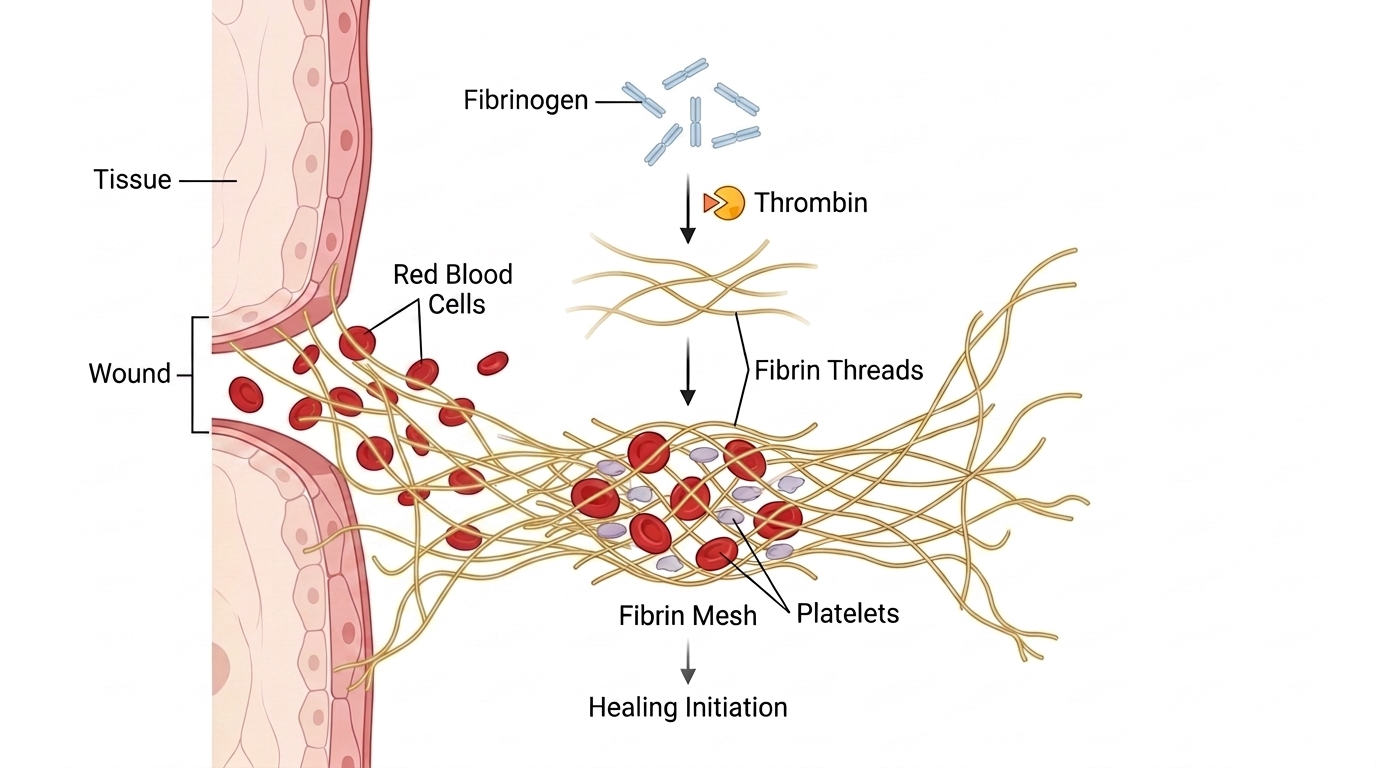
How Fibrin Seals a Wound
Three-panel medical diagram showing the disc damage spectrum: left panel shows an annular tear with nucleus material leaking into the tear activating inner nerve fibers causing discogenic pain; center panel shows a bulging disc with the intact annulus wall bowing outward compressing the nerve root causing radiculopathy; right panel shows a herniated disc with nucleus rupturing through the annular wall compressing and chemically irritating the nerve root causing severe radiculopathy and sciatica

Fibrinogen is converted by thrombin into fibrin threads that weave a mesh — trapping platelets and red blood cells to seal the wound and begin healing. AFI delivers this same process directly into the torn spinal disc.

Medical illustration for educational purposes only.

What Is an Annular Tear?

The spinal disc has two components: an outer ring — the annulus fibrosus — and an inner core — the nucleus pulposus. The annulus fibrosus is built from layered collagen fibers arranged in a cross-hatch pattern, giving the disc its strength and the ability to withstand the forces of movement and load. The nucleus pulposus, by contrast, is a gel-like core of water, proteoglycans, and collagen that acts as a shock absorber, distributing compressive forces evenly across the disc. When the outer ring tears or weakens from injury, the disc can bulge outward, herniate, or allow the inner material to leak and irritate nearby nerves. Any of these can cause significant chronic back pain and radiculopathy. Unlike bone and muscle, the disc is avascular, lacking a direct blood supply, and may not easily heal. If these injuries do not respond to non-operative care, one can consider annular fibrin injections.
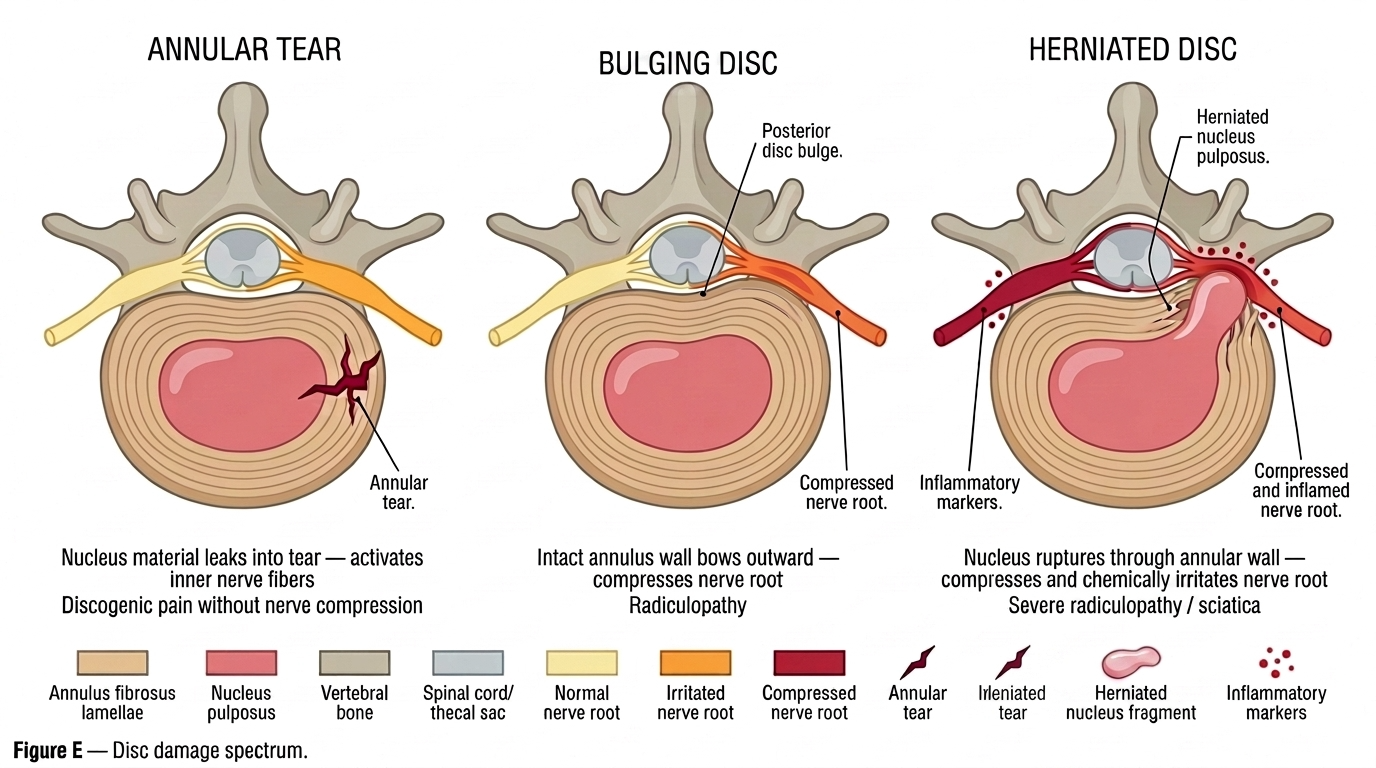
The Disc Damage Spectrum
Three-panel medical diagram showing the disc damage spectrum: left panel shows an annular tear with nucleus material leaking into the tear activating inner nerve fibers causing discogenic pain; center panel shows a bulging disc with the intact annulus wall bowing outward compressing the nerve root causing radiculopathy; right panel shows a herniated disc with nucleus rupturing through the annular wall compressing and chemically irritating the nerve root causing severe radiculopathy and sciatica

From an annular tear to herniation — each stage may cause nerve irritation and pain. AFI can help at any stage, but the window closes as degeneration progresses.

Medical illustration for educational purposes only.

What is the procedure?

Diagnostic Annulogram: A contrast dye is injected into the annulus fibrosus under live X-ray guidance. Dye that escapes through the annulus confirms the location and extent of the tear — identifying pathology that MRI alone may not identify.

Fibrin Sealant Injection: Through the same needle access, fibrin sealant is delivered into the damaged annulus. The components polymerize instantly on contact, forming a viscoelastic fibrin mesh that seals the annular defect and creates a biological scaffold — stimulating collagen deposition and natural tissue repair.
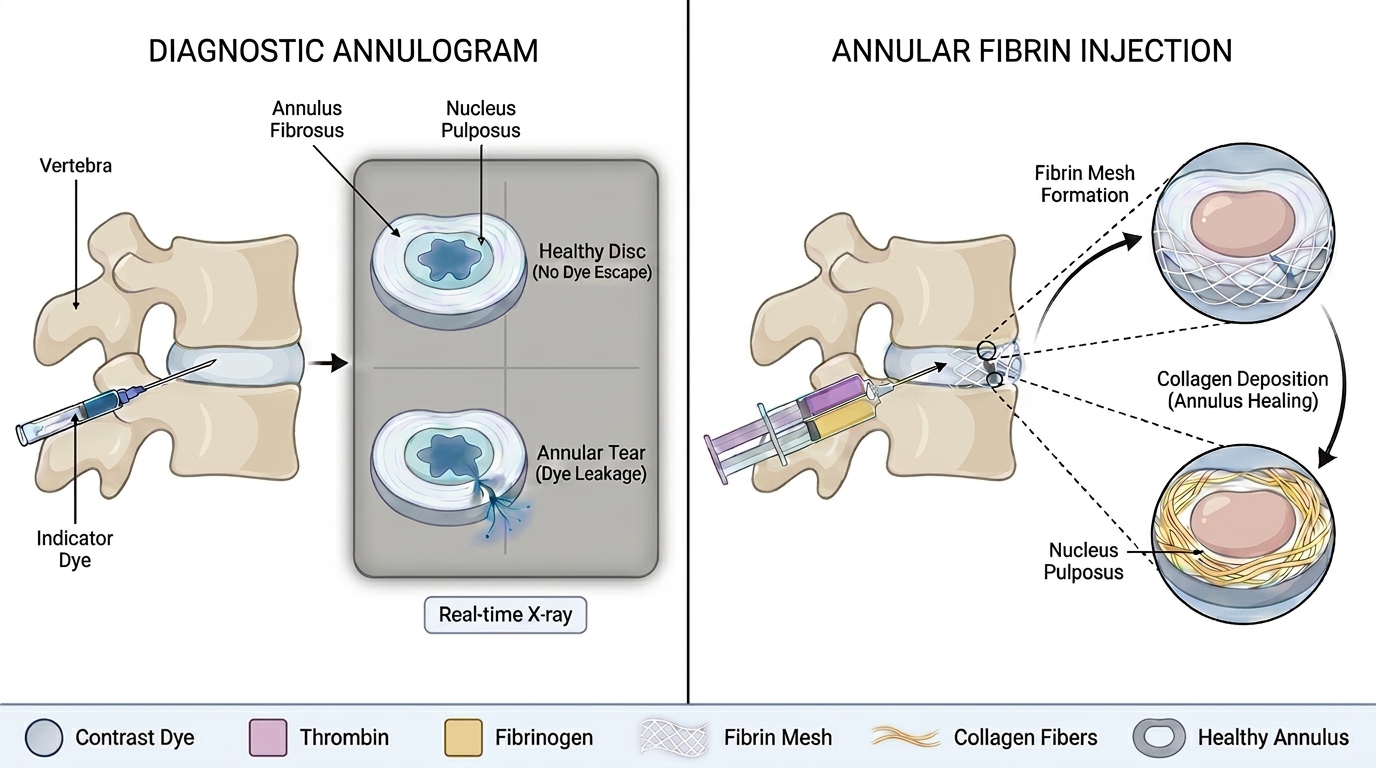
Diagnostic Annulogram and Annular Fibrin Injection
Side-by-side diagram: left shows diagnostic annulogram with contrast dye injected into disc revealing annular tear under real-time X-ray; right shows annular fibrin injection with thrombin and fibrinogen forming fibrin mesh and collagen deposition

Left: Contrast dye maps the annular tear under live X-ray. Right: Fibrinogen and thrombin are delivered to form a fibrin mesh, sealing the annulus and scaffolding collagen repair.

Medical illustration for educational purposes only.

The Evidence

Pauza et al. (2024), an 827-patient prospective registry, showed sustained, statistically significant improvements in pain and function through 36 months. At 12 months, 50% of patients achieved a Minimal Clinically Important Difference in the Oswestry Disability Index — of those, 74% saw ≥50% improvement and 40% saw ≥75% improvement. Patient satisfaction was 67–74% across all follow-up points, and function scores improved by more than 30% at 6 months, sustained through 3 years.

50%
of patients achieved clinically meaningful improvement at 12 months (Pauza et al., 2024)
827
patients in prospective registry through 36 months (Pauza et al., 2024)
67–74%
patient satisfaction across all follow-up points through 36 months
51%→16%
work impairment reduction at 26 weeks

Annular Fibrin Injections— A Research Timeline

Below is a timeline of AFI research, from early porcine disc repair studies to clinical trials, the annular fibrin treatment, its commercial branding as Discseel®, and the VA's 2025 coverage determination that eliminated access for Veterans.

Click any point on the timeline to learn more

2010s
2014
2016–2018
2022
2023
2024
Dec 2025
2026
Preclinical

2010s — Porcine Disc Repair Studies

Researchers exploring disc repair in porcine (pig) models demonstrated that fibrin sealant could seal annular defects and potentially slow disc degeneration. These preclinical studies established biological plausibility for fibrin as an annular repair agent and laid the conceptual foundation for eventual human trials.

References

1. Buser Z, Kuelling F, Liu J, Liebenberg E, Thorne KJ, Coughlin D, Lotz JC. Biological and biomechanical effects of fibrin injection into porcine intervertebral discs. Spine. 2011;36(18):E1201–E1209. doi:10.1097/BRS.0b013e31820566b2.
2. Buser Z, Liu J, Thorne KJ, Coughlin D, Lotz JC. Inflammatory response of intervertebral disc cells is reduced by fibrin sealant scaffold in vitro. J Tissue Eng Regen Med. 2012. doi:10.1002/term.1503.

Clinical Trials

2014 — Spinal Restoration / BIOSTAT Trials

Spinal Restoration Inc. developed Biostat Biologx — a proprietary fibrin formulation delivered into the intradiscal space via a propreitary injection device. Early Phase I/II trials reported promising pain reduction at 26 weeks. Results were encouraging but limited by small sample size.

The subsequent Phase III trial (NCT01011816) enrolled patients across 20 sites under blinded, controlled conditions but was terminated after fibrin showed no significant benefit over saline. Full per-site data was never published.

Critical distinction: Biostat technique targeted the nucleus pulposus — the soft inner core. Annular fibrin injection targets the annulus fibrosus — the outer ring. These are anatomically distinct targets with different proposed mechanisms. The Phase III failure of Biostat does not directly address whether intra-annular fibrin injection works.
References

1. Yin W, Pauza K, Olan WJ, Doerzbacher JF, Thorne KJ. Intradiscal injection of fibrin sealant for the treatment of symptomatic lumbar internal disc disruption: results of a prospective multicenter pilot study with 24-month follow-up. Pain Medicine. 2014;15:16–31.
2. Spinal Restoration Inc. BIOSTAT Biologx Phase III randomized controlled trial. ClinicalTrials.gov identifier: NCT01011816. https://clinicaltrials.gov/ct2/show/NCT01011816.

Commercialization

2016–2018 - Annular Fibrin Injections branded as Discseel®

In 2016, published work described "leaky disc syndrome" — a model in which annular fissures allow nucleus pulposus material to escape and provoke chemical radiculitis and pain. The proposed treatment was annular fibrin injections, a fibrin sealant injected into the annulus fibrosus to seal the fissure at its source, guided by a diagnostic annulogram. This was a distinct departure from BIOSTAT's intradiscal approach in target anatomy, formulation, and patient selection. Dr. Kevin Pauza branded this procedure as Discseel®

References

1. Pauza KJ, Wright C, Fairbourn A. Treatment of annular disc tears and “leaky disc syndrome” with fibrin sealant. Techniques in Regional Anesthesia and Pain Management. 2016. doi:10.1053/j.trap.2016.09.008.
2. USPTO: US8206448B2 (exp. 2028-12-11) · US8419722B2 (exp. 2026-11-19) · US8357147B2 (exp. 2027-07-16) · US8986304B2 (lapsed 2025-09-24). Discseel® trademark registration.

Independent Critique

2022 — Spinal Restoration Biostat Biologx Post-Hoc Analysis

Seeking scientific insights from the terminated Biostat clinical trial, Ju et al. conducted a analysis of the Phase III study data, which had enrolled patients across 20 sites before being discontinued. They were able to access data from only 1 of those 20 sites. At that site, the saline control arm had only 3 patients — while fibrin had 13. Saline showed near-complete pain relief (VAS 9.2) vs. fibrin (55.8) at 6 months, which the authors cited as statistically significant. The Ju et al. analysis is the primary study the VA cites in its 2025 non-coverage determination — despite the analysis' limited sample size and the fact that the Biostat trial used a different method and formulation than annular fibrin injection.

The n=3 problem: With only three saline patients at a single site, a single outlier responder drives the group mean to near-zero. This result is directionally interesting but statistically fragile — and cannot bear the weight placed on it by the VA's analysis.
Methodological non-equivalence: Ju et al. analyzed BIOSTAT BIOLOGX injected into the nucleus pulposus. This is not a study of annular fibrin injection. Annular fibrin injection uses allogeneic fibrin delivered into the annulus fibrosus following a diagnostic annulogram. Different procedure, different anatomical target, different formulation. The VA cites Ju as evidence against annular fibrin injection — but the two procedures share a name for the material used, not the method.
References

1. Ju DG, Kanim LE, Bae HW. Is there clinical improvement associated with intradiscal therapies? A comparison across randomized controlled studies. Global Spine Journal. 2022;12(5):756–764. doi:10.1177/2192568220963058.

Access

2023 — Physicians Begin Offering the Annular Fibrin Injections to Veterans

A subset of physicians trained in annular fibrin injection, some of them Veterans themselves, recognized that the procedure addressed a largely unmet need in the Veteran population: back pain, the most common service-connected condition in the VA system. Many of these patients had exhausted conservative care — physical therapy, epidural steroid injections, and other treatments — and were not surgical candidates, leaving them in pain with no logical next step. Veterans and their physicians pursued authorization through the VA Community Care program, which allows Veterans to receive care from outside providers when it is medically necessary, creating a legitimate obligation for the VA to consider the procedure on a case-by-case basis.

Why the VA matters: Unlike private insurers, the VA cannot simply decline coverage without a formal determination. The December 2025 CDI was the VA's mechanism to close that door formally — and retroactively foreclosed veterans who had been receiving the procedure under community care authorizations.
References

1. Veterans Access, Choice, and Accountability Act of 2014, as amended. 38 U.S.C. § 1703. VA community care eligibility (MISSION Act).
2. 38 U.S.C. § 1703(d)(1)(E). Eligibility for community care when VA cannot provide timely or geographically accessible care.

Registry Study

2024 — Annular Fibrin Registry Analysis

Retrospective cohort of 827 patients averaging 11.2 years of chronic low back pain, all having failed multiple prior treatments including surgery, PRP, and BMC. Enrolled October 2017–September 2021; published November 2024.

All six outcome measures (ODI, VAS back, VAS leg, EuroQOL, PROMIS GMH/GPH, NASS satisfaction) showed statistically significant improvement at every follow-up timepoint through 36 months (P<0.001), except PROMIS global mental health at 36 months. No serious adverse events were reported.

Signal: This is the first study of intra-annular fibrin at scale. With many patients failing prior treatments. Authors explicitly call for a randomized double-blind controlled trial.
Limitations: No control arm — patients serve as their own baseline controls. Single center, single operator. Retrospective analysis of prospective registry data. Approximately 40% dropout by 36 months.
References

1. Pauza KJ, et al. Intra-annular fibrin sealant injection for discogenic low back pain: a retrospective analysis of a prospective registry. Pain Physician. 2024;27(8):537–553.

The Ban

December 2025 — VA Non-Coverage Determination

The VHA Office of Integrated Veteran Care issued Coverage Determination IVC-CDI-00059, effective December 1, 2025, designating annular fibrin injections as investigational, experimental, and not medically necessary. The VA acknowledges the 2024 Annular Fibrin Registry — yet concludes that real-world evidence, a lack of on-label FDA indication, is not enough. That stance sits at odds with the direction Congress set in the 21st Century Cures Act, and is inconsistent with the VA's coverage of other commonly performed off-label procedures, such as epidural steroid injections.

The VA's CDI also conflates the Biostat intranuclear approach with an intra-annular approach — two procedures the memo does not treat as methodologically distinct.

What the VA gets wrong: The Ju 2022 paper analyzed BIOSTAT's nucleus pulposus injections — not annular fibrin injections.
What the VA gets right: No randomized controlled trial of intra-annular fibrin exists. The VA's evidentiary threshold is not unreasonable — the question is whether foreclosing access entirely, rather than allowing case-by-case authorization, is proportionate to the evidence gap and the severity of need in this patient population.
References

1. VHA Office of Integrated Veteran Care. Coverage Determination IVC-CDI-00059: Annular Fibrin Injections. US Department of Veterans Affairs; effective December 1, 2025.
2. Ju DG, Kanim LE, Bae HW. Is there clinical improvement associated with intradiscal therapies? A comparison across randomized controlled studies. Global Spine Journal. 2022;12(5):756–764. doi:10.1177/2192568220963058.

Structural Deadlock

2026 — CDI 00059: No Veteran Can Access Treatment

With CDI 00059 in effect, no Veteran can recieve coverage for annular fibrin injections — regardless of diagnosis, disease severity, or physician recommendation. Trained physicians how treated over 10,000 civilians. The VA's determination closes the only realistic coverage pathway for Veterans.

Veterans who have exhausted conservative care — physical therapy, epidural steroid injections, facet procedures — and who are not surgical candidates are left with few remaining options within the VA system. Those who can afford self-pay costs may access treatment. Those who cannot afford it have no path to treatment at all.

No path forward for veterans: Veterans with service-connected spinal injuries — often the most financially at risk — are disproportionately affected. The CDI does not distinguish between patients. It does not allow case-by-case physician authorization. It does not provide a compassionate use pathway. It closes the door completely.
References

1. VHA Office of Integrated Veteran Care. Coverage Determination IVC-CDI-00059: Annular Fibrin Injections. US Department of Veterans Affairs; effective December 1, 2025.
2. 38 U.S.C. § 1710(a)(1). Eligibility for hospital care, medical services, and nursing home care.
3. Veterans Access, Choice, and Accountability Act of 2014, as amended. MISSION Act, 38 U.S.C. § 1703(d)(1)(E). Eligibility for community care when VA cannot provide timely or geographically accessible care.
4. 38 U.S.C. § 1703(n)(1). Prohibition on limitations — Secretary shall not limit types of care if in the best medical interest of the veteran as determined by the veteran and their health care provider.
5. 35 U.S.C. § 287(c). Limitation on damages and other remedies — medical activity exception.

Why the VA's December 2025 Decision Must Be Reconsidered

VA CDI 00059 — Effective December 1, 2025

The VA's Decision & Its Impact

The CDI memo blocks VA authorization of annular fibrin injections and provides insurance carriers (Optum and TriWest) grounds to deny Veterans care, effectively eliminating access for Veterans who cannot afford self-pay costs. Veterans with service-connected spinal injuries — often financially and economically at risk — are disproportionately affected.

Legal

Conflicts with VA's Own Legal Obligations

When a Veteran and their physician agree that annular fibrin injection is the right treatment, federal law was written to protect that decision. The MISSION Act requires the VA to provide community care when:

"The covered veteran and the covered veteran's referring clinician agree that furnishing care and services through a non-Department entity or provider would be in the best medical interest of the covered veteran based upon criteria developed by the Secretary." — 38 U.S.C. § 1703(d)(1)(E), MISSION Act (Caring for Our Veterans Act of 2018)

Congress also built in a clear limit on how far the VA can go in restricting that care:

"The Secretary shall not limit the types of hospital care, medical services, or extended care services covered veterans may receive under this section if it is in the best medical interest of the veteran to receive such hospital care, medical services, or extended care services, as determined by the veteran and the veteran's health care provider." — 38 U.S.C. § 1703(n)(1), MISSION Act (Caring for Our Veterans Act of 2018)

CDI 00059 conflicts with the second provision. By categorically excluding annular fibrin injection regardless of individual circumstance, it imposes exactly the kind of blanket treatment restriction § 1703(n)(1) was written to prevent — one made by administrative policy before any Veteran or physician is ever heard.

Safety

Fibrin Sealant Is Already FDA-Approved — Not Experimental

Tisseel® fibrin sealant has been FDA-approved since 1998 with over 25 years of routine surgical use. The same sealant is already applied off-label during VA-covered spinal surgeries (laminectomies, fusions). Simultaneously authorizing those procedures while denying annular fibrin injections is contradictory.

Evidence

Registry Data Meets FDA Real-World Evidence Standards

The 21st Century Cures Act (21 U.S.C. § 355g) directed the FDA to establish a framework recognizing real-world evidence — including patient registries — as a valid basis for regulatory decision-making. It is our opinion, that the 827-patient annular fibrin registry meets that standard. The VA already accepts comparable registry and observational evidence for lumbar fusion, disc arthroplasty, and spinal cord stimulators. Applying a stricter evidentiary standard to AFI alone, without explanation, is an inconsistency the VA has not justified.

Economics

Denial Is Economically Counterproductive

Forcing Veterans from AFI directly to lumbar fusion — which carries 22.7% cumulative revision rates at 10 years and 25–40% adjacent segment disease — compounds costs across both healthcare and disability compensation. Preliminary modeling projects significant savings per 100 Veterans when AFI is used as a treatment step before fusion. As many Veterans may not require subsequent spinal fusion.

Ethics

A Direct Contradiction to Biomedical Ethics

Primum non nocere — first, do no harm.

When a physician determines that AFI is the appropriate next step and a Veteran provides informed consent, denying that treatment overrides the. Ethically, a procedure with lower invasiveness and lower complication rate (annular fibrin) should be chosen before a more invasive, more complex procedure (spinal fusion).

Equity

Creates Two-Tiered Healthcare

Veterans with personal resources can access AFI as a self-pay service. Those entirely dependent on VA coverage — often the most service-connected and financially at risk — cannot. A federally funded system designed to serve those who served should not replicate private-market access disparities.

Clinical Harm

The Window for Treatment Closes

Disc degeneration is progressive. Denying AFI during the early intervention window may allow significant disease progresssion to occur. With AFI then no longer an option.

What We're Asking For

  • Reconsideration of CDI 00059 on its merits — based on the actual AFI evidence, not on studies of anatomically distinct procedures.
  • Restoration of Veterans' right to access AFI when their physician determines it is in their best medical interest, consistent with the VA's obligations under the MISSION Act.
  • A responsible, evidence-generating path forward — one that does not force Veterans past a minimally invasive option and into irreversible surgery while the evidence base continues to develop.
  • Equal access regardless of personal wealth — the same treatment should not be available to Veterans who can pay out of pocket and denied to those who cannot.
Read the full rebuttal document

Make Your Voice Heard

Three ways you can help Veterans access annular fibrin injections. Every signature and every message to Congress moves the needle.

Sign the Petition

Add your name to our petition urging the VA to reconsider CDI 00059 and restore Veterans' access to a treatment supported by meaningful evidence and recommended by their physicians. Signatures from Veterans, family members, healthcare providers, and advocates all count.

Join Veterans, families, and advocates calling for change — every voice strengthens the case.

Sign the Petition

Contact Congress

Congressional pressure is the most effective lever for VA policy change. Click below to find your senators and representative. We have provided a template message explaining why CDI 00059 must be reconsidered.

Share This Page

Share this page with Veterans, friends, and family. Many Veterans — and their families — don't know this treatment exists or that the VA is blocking it. Sharing on social media, in Veteran community groups, or simply forwarding this URL can make an enormous difference.